Building Digital Marketing Expertise With a Marketing Expertise Framework
- Katina Ndlovu

- Feb 20
- 5 min read
Updated: Feb 23
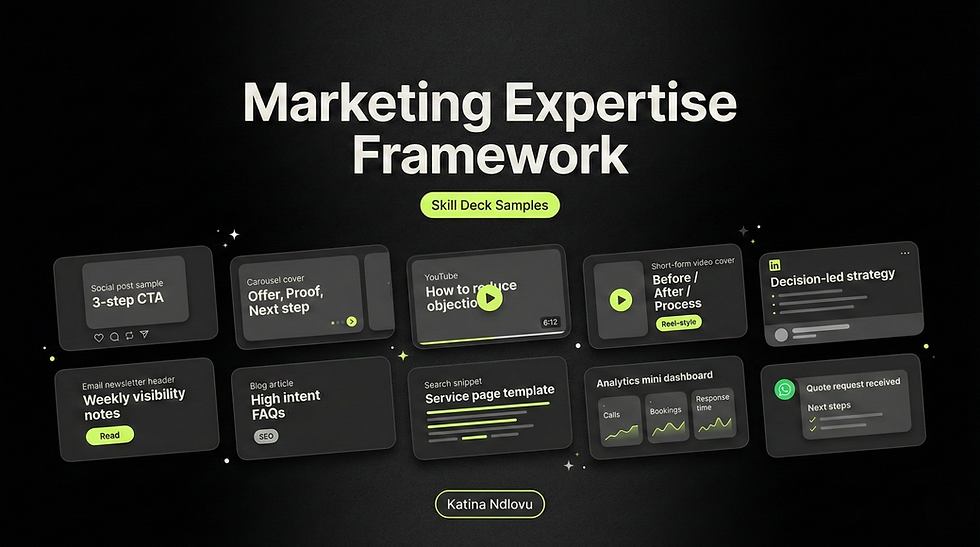
A marketing expertise framework is a structured way to build marketing skill without getting pulled into random tactics. If you want consistent results, you need a framework that links learning to outcomes. This post shows how to build a marketing expertise framework you can apply to real business goals.
What a marketing expertise framework is
A marketing expertise framework is a simple system for:
deciding what to learn next
practicing in a controlled way
measuring what changed
repeating what works
It helps you avoid “busy marketing”, where activity increases but results stay flat. In practice, the framework protects your time and improves decision-making.
Step 1: Define outcomes and constraints first
Start with outcomes you can measure. Then name the constraints that could block delivery.
Examples of outcomes:
increase qualified enquiries from your website
increase repeat purchases from existing customers
reduce cost per lead while keeping lead quality stable
Common constraints:
limited budget for ads
limited time for content
slow response time to enquiries
low trust signals (few reviews, weak proof, unclear offer)
If you use SMART goals, keep them practical. The point is not a perfect sentence. The point is focus and accountability. https://www.ucop.edu/local-human-resources/_files/performance-appraisal/How%2Bto%2Bwrite%2BSMART%2BGoals%2Bv2.pdf
Step 2: Choose the core skills that match your goals
Most businesses do not need to “master everything.” They need a small set of skills that support their current growth constraint.
A useful core skill stack:
Positioning and messagingCan you explain who you help, what you do, and why it matters in one minute?
Channel selectionChoose one primary acquisition channel and one retention channel. In South Africa, that often looks like a social platform plus direct follow-up via email or messaging.
Content and proofCan you show examples, outcomes, process, and answers to common objections?
Conversion basicsCan someone take the next step easily: call, form, book, or message?
MeasurementCan you see what drives traffic, what drives action, and what drives sales?
Tradeoff: adding more channels can increase reach, but it also increases execution cost. Depth usually beats breadth early.
Step 3: Set up a learning loop you can sustain
Expertise grows from short cycles, not long plans you never finish.
A simple learning loop:
pick one skill for 2 to 4 weeks
run one small campaign or experiment
review results weekly
document what changed and why
repeat or adjust
This is where a workflow matters. A content calendar, a basic asset library, and a weekly review rhythm remove friction. If you want a structured way to build and maintain these systems, start here: https://www.katinandlovu.info/marketing-strategy-seo-automation-services/workflows-and-systems
Step 4: Use tools as support, not as the strategy
Tools help when they reduce manual effort or improve visibility. They do not replace thinking.
A practical minimum set:
Analytics for your website so you understand acquisition and on-site behaviourGoogle’s setup guidance is a good reference for getting tracking in place. https://support.google.com/analytics/answer/9304153?hl=en
Platform insights so you can see what content and campaigns performMeta’s overview of Insights is a useful starting point if you use Facebook and Instagram. https://www.facebook.com/business/help/700570830721044
Constraint: tool data is directional. The tradeoff is certainty versus speed. Use data to choose priorities, not to claim perfect cause-and-effect.
Step 5: Build confidence through small, repeatable experiments
If you want hands-on skill quickly, run small experiments with one variable changed at a time.
Examples:
the same offer with two different headlines
the same content topic in two different formats (short video vs carousel)
the same landing page with one clearer call to action
Keep the budget small and the timeline short. You are buying learning, not trying to “win big” on the first run.
Step 6: Measure what matters to the business
Choose metrics that match the goal. Avoid vanity metrics unless they are clearly linked to conversions.
A practical measurement set:
Visibility: impressions, reach, profile views
Interest: clicks, saves, watch time, email sign-ups
Action: calls, form submissions, bookings, messages
Quality: lead-to-sale rate, repeat purchase rate, average order value
In practice, businesses improve fastest when they review these numbers weekly, then change one thing.
Common mistakes that slow down expertise
Changing direction every week because you saw a new tactic online
Trying to learn ads, content, email, SEO, and design at once
Publishing without proof (no examples, no process, no credibility signals)
Measuring only likes and views while enquiries stay flat
Collecting leads without follow-up (slow response kills conversion)
A simple 30-day marketing expertise framework plan
Week 1: Goals and tracking
set one measurable outcome
set one constraint you will work around
confirm analytics basics are in place
Week 2: Offer and message
tighten the headline and core offer
write a short FAQ section for your most common objections
Week 3: One content system
create a content calendar for two weeks
publish proof-based content (examples, process, customer questions)
Week 4: One experiment
test one variable (headline, audience, format, call to action)
review weekly results and document what changed
If you want more practical strategy notes and systems thinking, you can browse: https://www.katinandlovu.info/blog
FAQs
1. What is a marketing expertise framework?
A marketing expertise framework is a structured system for deciding what to learn, testing it in practice, measuring results, and repeating what works.
2. Why is a marketing expertise framework better than trying random tactics?
It connects learning directly to measurable business outcomes and reduces wasted effort on activities that do not improve enquiries or sales.
3. How do I choose which marketing skills to focus on first?
Start with your main business goal and current constraint. Then choose the core skills that directly support that outcome, such as positioning, one acquisition channel, and conversion basics.
4. How long should a marketing learning cycle last?
A practical cycle is 2 to 4 weeks. Choose one skill, run one experiment, review results weekly, and document what changed.
5. What metrics should I track in a marketing expertise framework?
Track visibility, interest, action, and quality metrics. Prioritise calls, form submissions, bookings, and lead-to-sale rates over likes and views.
6. How can I test marketing improvements without wasting budget?
Run small, controlled experiments where you change one variable at a time, such as a headline, format, or call to action, and keep the budget and timeline limited.
7. What are common mistakes that slow marketing expertise development?
Frequent direction changes, learning too many channels at once, publishing without proof, focusing only on vanity metrics, and failing to follow up on leads.
Citations and Sources (external URLs used)
Additional Reading (in-body internal URLs used)
About the Author
Katina Ndlovu is a search visibility and personal branding strategist. I help business owners build clear marketing systems, strengthen credibility, and improve how their digital presence converts attention into enquiries.
If you want help building a practical marketing framework for your business, contact me here: https://www.katinandlovu.info/contact-search-visibility-strategist
If your business has evolved but your brand still reflects an earlier version of what you do, this work focuses on realigning positioning so your expertise is understood accurately.
You can explore related case studies below or get in touch to discuss how your brand is currently being positioned and interpreted.


Comments