How to Get Your First 5 Customers in South Africa
- Katina Ndlovu

- Feb 24
- 5 min read
Getting your first customers is less about “marketing everywhere” and more about doing a few things consistently. This guide shows how to get your first 5 customers in South Africa using network outreach, helpful content, referrals, and local search. You will also learn how to turn what works into a simple weekly routine you can keep running.
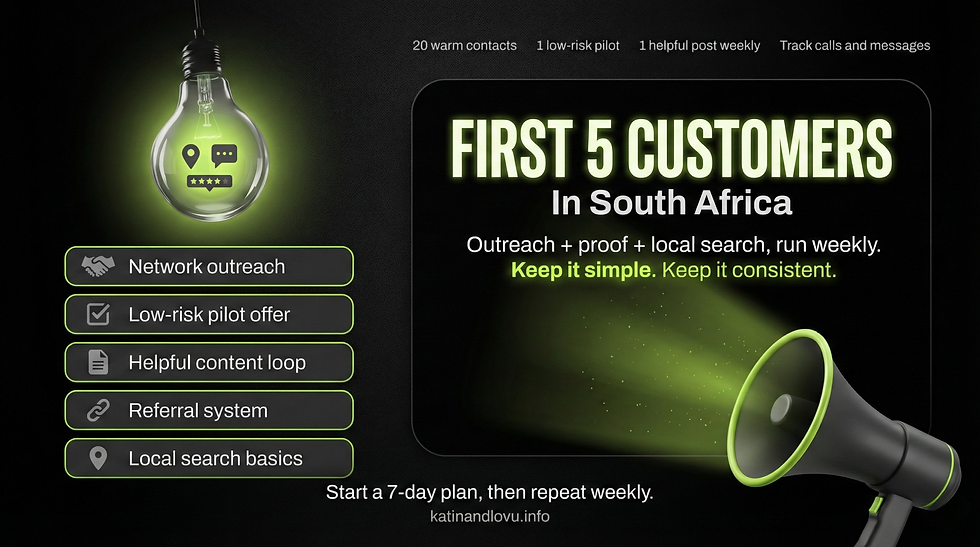
How to get your first 5 customers in South Africa
Start with your network
Most first customers come from people who already trust you, even if they are not buyers themselves. The goal is not to pitch everyone. The goal is to start a few low-risk conversations that lead to introductions.
A practical outreach list
Write down 20 people who know your work and values.
Prioritise 10 who are close to your target market or who connect people in your space.
Keep notes on what you last spoke about. Your message should not feel generic.
A simple message you can adapt
Keep it short and respectful:
“I’m helping businesses with [one specific problem]. I’m offering a small, low-risk pilot to prove the result. If this is relevant to you, I can share details. If not, and you know someone who is dealing with this, an intro would help.”
Constraint: your network is a small pool. You will need to add new contacts weekly once you have worked through it.
Offer a low-risk pilot that is easy to say yes to
A pilot is a controlled first step. It reduces buyer risk and gives you proof you can reuse.
What a good pilot includes
A clear outcome (one measurable improvement)
A defined scope (what is included, what is not)
A start date and a short timeframe
A simple price that matches the scope
A decision point at the end (continue, expand, or stop)
Tradeoff: pilots limit revenue in the short term. The upside is speed and clarity.
If you want to build pilots and follow-up into a repeatable workflow, this is the system layer I focus on:https://www.katinandlovu.info/marketing-strategy-seo-automation-services/workflows-and-systems
Publish content that answers buyer questions
Early content should not try to impress. It should reduce confusion.
A simple content loop
Pick one question buyers ask repeatedly.
Answer it in plain language in one channel (LinkedIn, a community group, or a blog post).
Repurpose the same answer into a second channel.
End with one small action the reader can take in five minutes.
Constraint: content takes time to compound. If you need fast results, pair content with outreach.
Build a referral engine that does not feel awkward
Referrals work best when they follow a clear “win moment”. Do not wait for people to guess you want introductions.
Three steps to steady referrals
Ask at the right time: after a visible improvement or a thank you message.
Make it easy: give one line they can forward and the best way to contact you.
Close the loop: thank them and update them on what happened.
Tradeoff: referrals depend on delivery quality. If your delivery is inconsistent, asking for referrals too early can backfire.
Make sure your digital presence confirms trust
When someone hears about you, they search your name. Your online presence needs to confirm what you promised in the conversation.
One-page minimum setup
A clear statement of what you do and who it is for
Proof you can support (examples, testimonials, or a simple case note)
A next step (call, form, or booking route)
Local search quick wins
If you serve a local area, set up your Google Business Profile and keep it accurate. Google says local ranking is mainly based on relevance, distance, and prominence.https://support.google.com/business/answer/7091?hl=en
Also follow Google’s guidance on representing your business accurately, especially for name and address details.https://support.google.com/business/answer/3038177?hl=en
Constraint: local search is rarely instant. It improves faster when your details are correct and you collect a few honest reviews.
Play the long game with simple systems
Once you land your first customers, your next risk is inconsistency. A lightweight system prevents you from restarting every week.
Build a weekly operating rhythm
Mondays: review your pipeline, send 5 outreach messages, follow up on open threads.
Wednesdays: publish one helpful post based on a real buyer question.
Fridays: close loops, send thank you notes, ask for a review when a win is clear, write down one lesson.
Save what works. Name your templates. Keep them in one folder.
Channel comparison
Choose one main channel and one support channel. Review results every four weeks.
Channel | Best for | Time to first lead | Main risk |
Network outreach | First customers and early proof | Fast, 1–2 weeks | Small pool if you do not add new contacts |
Helpful content | Authority and inbound enquiries | Medium, 4–8 weeks | Requires steady posting and focus |
Referrals | Warm, high-fit leads | Medium, depends on delivery cycle | Weak if you do not ask and follow up |
Local search | Services with local demand | Medium, 2–8 weeks | Needs reviews and correct profile data |
A 7-day plan you can start today
Day 1: Write your one-sentence offer and your pilot scope.
Day 2: List 20 people and send 5 tailored messages.
Day 3: Send 5 more messages and set 2 short calls.
Day 4: Publish one helpful post answering a common buyer question.
Day 5: Follow up on every open thread. No new pitch, just clarity.
Day 6: Create or clean up your one-page online presence.
Day 7: Review what worked and repeat the strongest channel next week.
FAQs
1. What is the fastest way to get your first 5 customers in South Africa?
Network outreach is usually the fastest channel. Start with people who already trust you and ask for relevant introductions or pilot conversations.
2. What should a low-risk pilot offer include?
A clear measurable outcome, defined scope, short timeframe, simple pricing, and a decision point at the end.
3. How many people should I contact when starting out?
Begin with a list of 20 people, prioritise 10 close to your target market, and send 5 tailored messages per day.
4. When should I ask for referrals?
Ask after a visible improvement or a clear win moment. Provide a short message they can forward and close the loop afterward.
5. Do I need a website to get my first customers?
At minimum, you need a one-page online presence that confirms what you do, who it is for, proof of work, and a clear next step.
6. How important is Google Business Profile for local services?
If you serve a local area, your Google Business Profile improves trust and visibility. Ranking depends on relevance, distance, and prominence.
7. How long does it take for helpful content to generate leads?
Content typically takes 4–8 weeks to produce consistent inbound enquiries and works best when paired with outreach.
8. What weekly system helps maintain consistency?
Review pipeline and send outreach on Mondays, publish helpful content on Wednesdays, and close loops and request reviews on Fridays.
Citations and Sources
Additional Reading
If you want a second set of eyes on your first-customer plan, contact me here: https://www.katinandlovu.info/contact-search-visibility-strategist
About the Author
Katina Ndlovu is a search visibility and personal branding strategist. I help founders and service businesses build practical customer acquisition systems, with clear messaging, tight follow-up, and metrics they can actually use.
If your business has evolved but your brand still reflects an earlier version of what you do, this work focuses on realigning positioning so your expertise is understood accurately.
You can explore related case studies below or get in touch to discuss how your brand is currently being positioned and interpreted.


Comments