How to Check if a Business Name is Already Registered Locally
- Katina Ndlovu

- Feb 12
- 4 min read
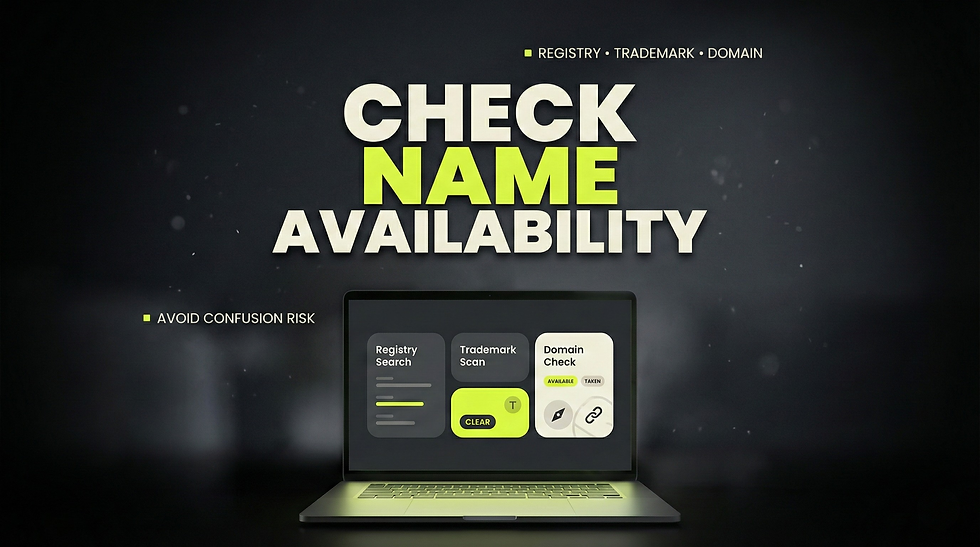
If you are asking how to check if a business name is already registered locally, the fastest approach is to check three layers: your local business registry, trademark records, and domain availability. This means you reduce the risk of picking a name you cannot legally use, cannot protect, or cannot build online without confusion.
How to check if a business name is already registered locally
Why name availability checks matter
A name can be “available” in one place and blocked in another.
A business registry check helps you avoid local conflicts.
A trademark check helps you avoid brand-level conflicts in your category.
A domain check helps you avoid online confusion and lost traffic.
Constraint: availability checks reduce risk. They do not eliminate it. Two names can be “different” legally but still too similar in the market.
Step 1: Search your local business registry
Start with the official registry where businesses are recorded in your area.
How to do it
Go to the official business registration authority website for your country or region.
Find the name search function (often called “company search” or “name search”).
Search your exact name first.
Then search close variants: spacing, plurals, and word order.
Note any names that look or sound similar in your category.
In South Africa, the official starting point is CIPC.https://www.cipc.co.za/
How to interpret the results
Exact match found: treat it as taken. Move to a different name direction.
Very similar name found: assume confusion risk. Even if it is technically allowed, it can weaken trust and make SEO harder.
No match found: proceed, but do not stop here. You still need trademark and domain checks.
Step 2: Check trademark risk
A trademark is tied to how a name identifies goods or services in a category. A local business registry check does not protect you from trademark conflict.
The practical way to do it
Identify your category (what you sell and who you sell it to).
Search your country’s trademark records for the exact name and close variants.
Pay attention to similar names in related categories, not only exact matches.
If you plan to expand into other regions, consider checks there too.
If you need a clear primer on what trademarks are and why they matter, WIPO’s overview is a reliable reference point.https://www.wipo.int/trademarks/en/
Constraint: trademark similarity is not only spelling. It includes sound, meaning, and category overlap. If the name is central to your brand, professional advice can be worth the cost.
Step 3: Check domain availability
Even if the name is legally available, a taken domain can create brand friction.
What to check
Search for your preferred domain in the extensions you are willing to use.
Check whether the domain is active, parked, or used by a business in your category.
Decide what “good enough” looks like. For many businesses, a clean domain beats a perfect name.
ICANN’s domain registration overview is useful if you want to understand how domain registration works at a high level.https://www.icann.org/resources/pages/domain-name-registration-process-2023-11-02-en
Tradeoff: changing spelling to “force” a domain can backfire. If people cannot type the name easily, they will not find you again.
Step 4: Check social handles and search visibility
People will search your name before they contact you.
Quick checks that catch problems early
Search the name on Google with your city, category, and service keywords.
Look for businesses that sound similar, even if spelled differently.
Check major social platforms for handle availability.
Scan review platforms and directories that matter in your category.
This is less about legality and more about confusion risk. Confusion slows word-of-mouth and weakens referrals.
Step 5: Check local directories and associations
Some businesses show up in directories before registry information feels “easy to find.”
Look at:
Chamber of commerce listings
Local business directories
Industry associations
Marketplace platforms relevant to your niche
If you find a near-match in your area, treat it seriously. You do not want to build a brand that constantly needs explanation.
Step 6: Understand naming rules and restricted terms
Many jurisdictions restrict certain words or require approval for them.
Common examples include terms like “bank,” “insurance,” “university,” or words that imply government affiliation. Some regions also require names to be “distinguishable” from existing names, not only different.
Constraint: rules vary by country and sometimes by province or state. Always read the guidance from your local registry authority before you submit a name.
Step 7: Keep a shortlist of backup names
Name checks often eliminate your first option. That is normal.
A practical approach:
Create 5 to 10 serious candidates.
Run the same checks on each one.
Choose the name that is clear, distinctive, and buildable online.
If you want a structured way to choose names that support positioning and long-term clarity, this is the most relevant service area in my work:https://www.katinandlovu.info/marketing-strategy-seo-automation-services/brand-design-and-positioning
A simple local name-check checklist
Registry search done (exact + variants)
Trademark screening done (exact + similar, category-aware)
Domain plan confirmed (usable, memorable)
Social handles checked (or a consistent alternative decided)
Google search scan done (confusion risk understood)
Backup names ready
For more practical brand strategy reading, you can browse here:https://www.katinandlovu.info/blog
Citations and Sources (external URLs used)
Additional Reading (in-body internal URLs used)
About the Author
Katina Ndlovu is a search visibility and personal branding strategist. I help entrepreneurs make clear naming and positioning decisions so their brand is easier to trust and easier to find.
Contact me here: https://www.katinandlovu.info/contact-search-visibility-strategist
If your business has evolved but your brand still reflects an earlier version of what you do, this work focuses on realigning positioning so your expertise is understood accurately.
You can explore related case studies below or get in touch to discuss how your brand is currently being positioned and interpreted.


Comments