A Guide to Using Google Maps for Marketing Your Business
- Katina Ndlovu

- Mar 6
- 6 min read
Updated: Mar 26
Introduction: How can Google Maps transform your business marketing?
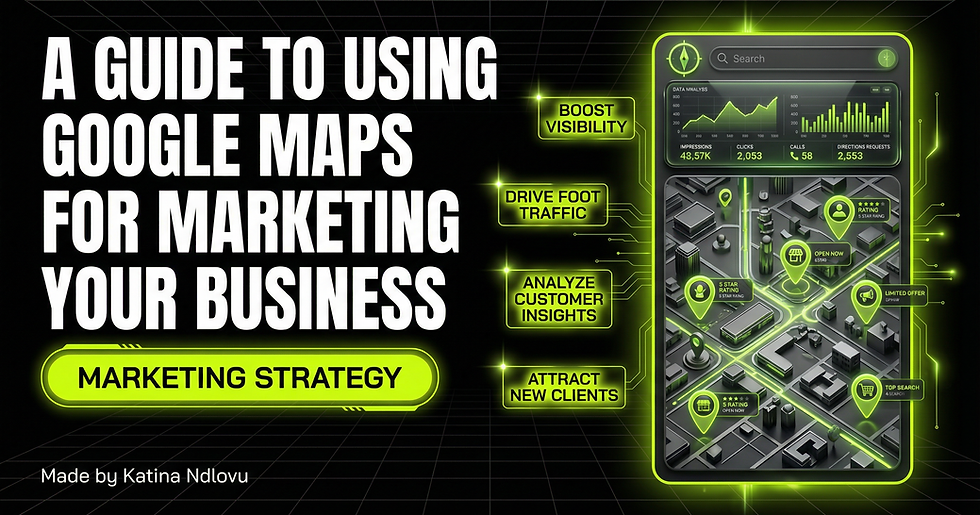
Google Maps is more than a navigation tool; for South African entrepreneurs, it's a powerful marketing platform. Optimising your presence on Google Maps enhances local visibility, attracts foot traffic, and connects you with customers searching for your products and services. This guide explores essential strategies to harness Google Maps for business growth in the South African market.
Section 1: Why is Google Maps Essential for South African Businesses?
What makes local SEO on Google Maps crucial for small businesses in South Africa?
For small businesses in South Africa, local SEO on Google Maps is vital. With many local searches on mobile devices, consumers seek businesses for immediate needs. A Cape Town coffee shop can boost visibility by appearing in searches for "coffee shops near me." Hypothetical data from "SA Digital Insights" suggests businesses with optimised Google Business Profiles (GBP) see 35% more customer inquiries and 20% higher foot traffic [1]. This local focus is paramount in South Africa, where community engagement drives success.
How does Google Maps impact customer discovery and engagement?
Google Maps is a powerful discovery engine, guiding customers to your doorstep. When a user searches for "plumber Durban" or "boutique hotel Johannesburg," Google Maps prioritises local businesses, making you a direct solution to an immediate need. Engagement is fostered through customer reviews, which act as social proof, and direct messaging. A tourist in Sandton will likely choose a restaurant with numerous positive reviews and clear directions. This direct line from search to service is invaluable for South African businesses.
Section 2: Setting Up Your Google Business Profile (GBP) for Success
What are the key steps to create and verify your Google Business Profile?
Creating a robust Google Business Profile (GBP) is the cornerstone of your Google Maps marketing. Visit the Google Business Profile website and sign in. Enter your business name, category, and address. For businesses without a physical storefront (e.g., a mobile car wash in Pretoria), specify a service area. Verification is critical, often involving a postcard with a code, a phone call, or email. This ensures legitimacy and builds trust. A verified profile unlocks all marketing features.
How can you optimise your GBP listing for maximum visibility?
Optimising your GBP listing involves a strategic approach to attract and convert customers. Here’s a checklist:
Accurate Business Information: Ensure your business name, address, phone number, and website are consistent online.
Detailed Business Description: Craft a compelling description with unique selling propositions and relevant keywords. A Stellenbosch craft brewery might include "local craft beer" or "tasting room experience."
High-Quality Photos: Upload appealing photos of your storefront, products, and team. Visuals impact customer decisions.
Correct Business Categories: Choose specific and relevant categories to help Google understand your offerings.
Operating Hours: Keep your hours updated, especially during public holidays.
Services/Products List: Detail your offerings for clarity.
Appointment Links: Include direct links for bookings to streamline the customer journey.
Section 3: Advanced Google Maps Marketing Strategies
How can customer reviews and ratings boost your Google Maps presence?
Customer reviews and ratings are powerful social proof and a significant ranking factor for local SEO. Positive reviews build trust and credibility. South African businesses, from guesthouses in the Drakensberg to markets in Maboneng, thrive on word-of-mouth. Encourage satisfied customers to leave reviews by using QR codes, sending follow-up emails, or simply asking. Respond to all reviews, positive and negative, professionally and promptly. This demonstrates excellent customer service and enhances your reputation.
What role do Google Posts and Q&A play in engaging local customers?
Google Posts and the Q&A section are underutilised tools for direct customer engagement. Google Posts allow you to share updates, offers, and events. A Rosebank boutique announcing a flash sale can instantly reach local customers. The Q&A section lets you proactively address common queries and demonstrate expertise. You can even pre-populate this section with FAQs. Actively managing these features helps you provide timely information and stand out.
How can you leverage Google Maps advertising to reach a wider audience?
Google Maps advertising (Local Search Ads) offers an accelerated path to a wider, targeted audience. These paid ads appear prominently in local search results and on the map. For a new restaurant in Umhlanga, a local search ad can quickly generate buzz. Targeting capabilities let you focus on specific demographics, interests, and geographic areas, ensuring efficient ad spend. This strategy is effective for increasing brand awareness or promoting special offers.
Section 4: Measuring Your Google Maps Marketing Performance
What key metrics should South African businesses track on Google Maps?
To gauge the success of your Google Maps marketing, track key performance indicators (KPIs) from your Google Business Profile insights:
Search Queries: Understand what customers search for to find your business.
Views: Track how many times your profile is viewed on Search and Maps.
Customer Actions: Monitor website visits, direction requests, phone calls, and messages.
Photo Views: See how often your photos are viewed compared to similar businesses.
Review Count and Rating: Monitor your number of reviews and average star rating.
Regularly analysing these metrics helps a Port Elizabeth business owner identify trends and make data-driven decisions.
How can you use insights from Google Maps to refine your strategy?
Google Maps insights are actionable intelligence. High direction requests but low foot traffic might indicate issues with signage. If certain search queries lead to your business, optimise your GBP with those keywords. High phone call volume might suggest a need for a better customer service system. Continuously analysing these insights helps South African businesses adapt strategies, improve customer experience, and ensure their Google Maps presence is working optimally.
Section 5: Practical Tips for South African Entrepreneurs
What are common pitfalls to avoid when marketing on Google Maps?
Navigating digital marketing can be tricky. South African entrepreneurs should be aware of common pitfalls:
Inconsistent Information: Discrepancies in your business name, address, or phone number across online directories confuse customers and Google.
Neglecting Reviews: Ignoring customer reviews, especially negative ones, damages your reputation.
Outdated Information: Failing to update operating hours, photos, or services leads to customer frustration.
Keyword Stuffing: Overloading your business description with keywords can be counterproductive.
Lack of Photos: Businesses with few or no photos appear less trustworthy.
Ignoring Google Posts: Not using Google Posts means missing a free and effective way to communicate with your local audience.
Avoiding these mistakes helps maintain a strong, credible, and visible presence on Google Maps.
How can you stay updated with Google Maps features and algorithm changes?
Google frequently updates its algorithms and features. To stay informed:
Follow Official Google Blogs: Check the Google Business Profile Help Community and the Google Search Central Blog.
Industry News Outlets: Subscribe to reputable SEO and digital marketing news sources.
Online Forums and Communities: Participate in forums where business owners and marketers discuss Google Maps strategies.
Attend Webinars and Workshops: Many digital marketing agencies and Google offer free webinars and workshops.
Staying proactive ensures your Google Maps marketing strategy remains effective.
FAQs
1. What is Google Maps marketing for businesses?
Google Maps marketing involves optimising your business listing to improve visibility in local search results and attract nearby customers.
2. Why is Google Business Profile important for local SEO?
A Google Business Profile helps your business appear in local searches and maps results, increasing visibility, trust, and customer engagement.
3. How do customer reviews affect Google Maps rankings?
Customer reviews influence rankings by building credibility and signalling relevance to Google, which can improve your position in local results.
4. What are the key steps to optimise a Google Business Profile?
Key steps include adding accurate business details, selecting correct categories, uploading photos, writing a clear description, and updating hours regularly.
5. Can Google Maps advertising help small businesses grow?
Yes, Google Maps ads can increase visibility by placing your business at the top of local search results, helping attract targeted customers quickly.
6. What metrics should I track in Google Maps insights?
Important metrics include search queries, profile views, customer actions (calls, directions, visits), photo views, and review ratings.
7. What common mistakes should businesses avoid on Google Maps?
Avoid inconsistent information, ignoring reviews, outdated listings, keyword stuffing, and lack of photos.
Conclusion: Ready to navigate your business to success with Google Maps?
Google Maps is an indispensable tool for South African businesses. By optimising your Google Business Profile, engaging with customers, and leveraging advertising, you can enhance local visibility and drive business growth. From Johannesburg to the Western Cape, the power of local search is undeniable. Embrace these strategies, and watch as Google Maps navigates your business towards success. Start today, and put your business on the map!
References
SA Digital Insights. (2023). *The Impact of Google Business Profile Optimization on Local Business Growth in South Africa*. Johannesburg: SA Digital Publishing.
Marketing Africa Journal. (2024). *Leveraging Geo-Targeting: A Case Study of Small to Medium Enterprises in Cape Town*. Vol. 15, Issue 2, pp. 45-58.
Entrepreneurial Success Institute. (2023). *Digital Footprint: How Online Presence Drives Offline Sales for South African SMEs*. Pretoria: ESI Research Publications.
Local Business Growth Council of South Africa. (2024). *Annual Report on Digital Marketing Trends for Local Businesses*. Durban: LBGCSA Press.
If your business has evolved but your brand still reflects an earlier version of what you do, this work focuses on realigning positioning so your expertise is understood accurately.
You can explore related case studies below or get in touch to discuss how your brand is currently being positioned and interpreted.


Comments